

What is Non-Woven Fabric? Types, Manufacturing Processes & Applications
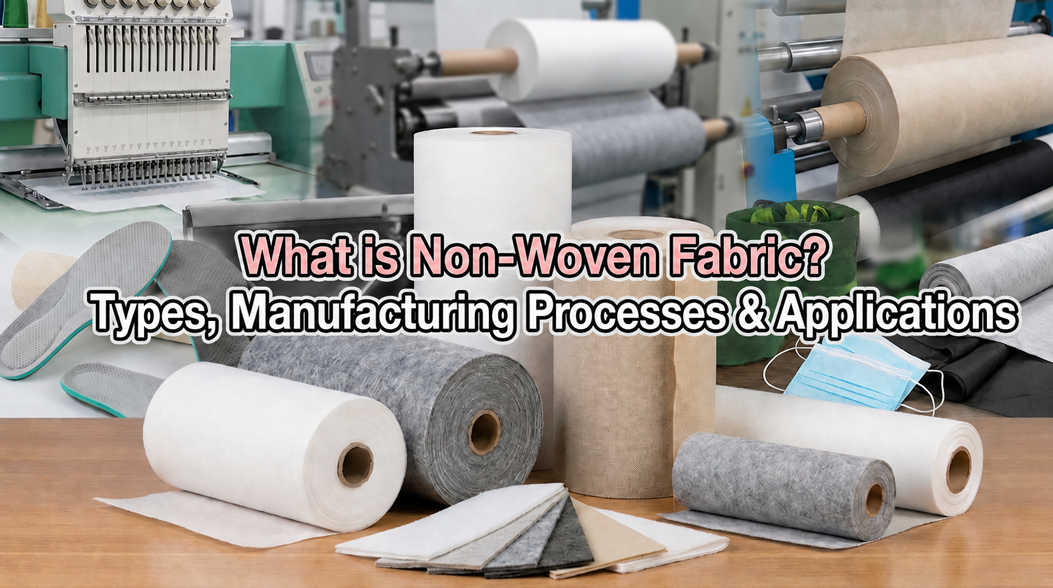
Nonwoven fabric is a sheet-like material made by directly laying, entangling, or bonding fibers together without going through the traditional textile processes of spinning and weaving. For this reason, it is referred to as “nonwoven fabric.”
By adjusting fiber types, manufacturing processes, and thermal bonding methods, nonwoven fabrics can be engineered with varying strength, breathability, thickness, toughness, and functional properties. As a result, they are widely used across global industries—from footwear reinforcement fabrics and medical materials to automotive interiors, home décor, and even geotextiles, agriculture, and environmentally friendly materials.
What is Nonwoven Fabric? Understanding Its Manufacturing Principles and Characteristics
Nonwoven fabrics are primarily made from polyester (PET), polypropylene (PP), or other functional fibers. These fibers are mechanically entangled to form a fabric with structural strength and integrity.
Taking the industry's most common needle-punched nonwoven fabric as an example, the fabric surface undergoes repeated penetration by dense steel needles, causing the fibers to interlock tightly and form a strong yet resilient material.
Many professional nonwoven manufacturers adopt specialized stiffening processes that do not rely on traditional resin impregnation. This approach eliminates the risk of chemical residues, increases production efficiency, and offers better environmental performance.
After stiffening, the fabric gains improved rigidity, abrasion resistance, durability, and high load-bearing support, making it ideal for footwear materials, automotive components, reinforcement fabrics, and structural support applications.
Key reasons why nonwoven fabrics are widely adopted across industries include:
- Lightweight yet highly durable
- Adjustable density, thickness, and softness or stiffness
- High processing flexibility, suitable for lamination, thermal bonding, and cutting
- Can be engineered with waterproof, antibacterial, heat-resistant, and other functional properties
- Well-suited for mass production with excellent cost efficiency
Types of Nonwoven Fabrics: Common Classifications and Material Properties
Nonwoven fabrics can be classified based on manufacturing methods, fiber density, and intended applications. The main categories include:
1. General nonwoven fabrics
Commonly used in packaging, household products, and medical disposables. These fabrics feature uniform surfaces and good softness, and can be designed for waterproof or breathable performance as required.
2. Needle-punched nonwoven fabrics
Fibers are mechanically entangled through steel needle penetration. Key advantages include high strength, durability, and the absence of chemical binders. These fabrics are widely used in footwear reinforcement, leather backing, automotive structural fabrics, and industrial filtration materials.
3. High-density nonwoven fabrics
Featuring tightly packed fibers, these fabrics offer excellent strength, rigidity, abrasion resistance, and pressure resistance. They are suitable for applications requiring structural support, such as midsole boards and leather lamination base fabrics.
4. High-strength nonwoven fabrics
Produced through needle punching combined with specialized stiffening techniques to enhance rigidity and structural strength. These are commonly used in high-demand applications such as footwear reinforcement fabrics, luggage structural layers, and automotive interior supports.
5. Filling nonwoven fabrics
Soft and lofty, used for sound insulation, shock absorption, and thermal insulation. Typical applications include automotive soundproofing materials, building acoustic layers, and mattress padding.
6. Functional nonwoven fabrics
Designed with multiple specialized functions, such as:
- Antibacterial nonwoven fabrics: for medical and hygiene products
- Bamboo charcoal nonwoven fabrics: deodorizing and moisture-absorbing applications
- Far-infrared nonwoven fabrics: heat retention and circulation enhancement
- Water-repellent nonwoven fabrics: outdoor products and agricultural covers
- Thermal insulation nonwoven fabrics: building and home décor applications
- Geotextile nonwoven fabrics: drainage, reinforcement, and separation in civil engineering
These functional products can be customized by adjusting fiber formulations and manufacturing processes, making them preferred materials for many branded applications.
Applications of Nonwoven Fabrics Across Industries
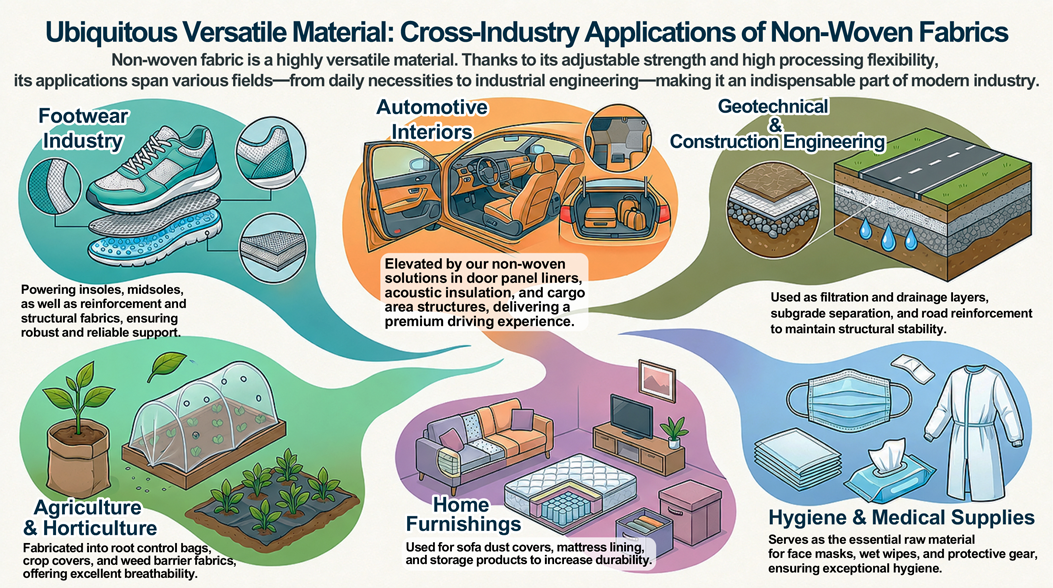
Thanks to their adjustable strength and high processing flexibility, nonwoven fabrics are widely used in the following industries:
1. Footwear Industry
- Footwear reinforcement fabrics
- Insole and midsole components
- Structural fabrics for softness and stiffness control
Needle-punched nonwoven fabrics are commonly used in global footwear manufacturing due to their excellent support performance.
2. Automotive Interior Materials
- Door panel backing
- Sound insulation materials
- Trunk and luggage compartment structural fabrics
With abrasion resistance, heat resistance, and strong support properties, nonwoven fabrics enhance vehicle quality and comfort.
3. Geotechnical and Construction Engineering
- Filtration and drainage layers
- Foundation separation
- Road reinforcement fabrics
High-density and high-strength nonwoven fabrics can withstand heavy loads while maintaining structural stability.
4. Agriculture and Horticulture
- Tree planting bags
- Cover fabrics and thermal blankets
- Weed control fabrics
With excellent breathability and weed suppression performance, nonwoven fabrics are widely used in agriculture.
5. Home Décor Materials
- Sofa base and backing fabrics
- Mattress and furniture linings
- Structural fabrics for storage products
These materials improve durability and provide additional structural support.
6. Hygiene and Medical Products
- Mask materials
- Wet wipe substrates
- Protective materials
Hygienic and highly customizable, nonwoven fabrics are essential materials for medical disposables.
Nonwoven Fabrics: An Essential Material Across Industries
With advantages such as lightweight construction, durability, and high processing flexibility, nonwoven fabrics can be engineered into high-density, high-strength, or functional materials to meet diverse needs. They are indispensable base materials in many manufacturing sectors, from footwear and automotive components to civil engineering, agriculture, and home décor products.
For companies seeking high-strength nonwoven fabrics produced through environmentally friendly processes with no chemical residues, selecting a supplier with proven technical expertise and quality certification is essential.
This ensures consistent quality, durability, and product performance. As markets increasingly demand high value-added products, choosing the right nonwoven materials and manufacturing partners has become a key factor in maintaining and enhancing competitive advantage.